The Month My Journal Belonged to Other People
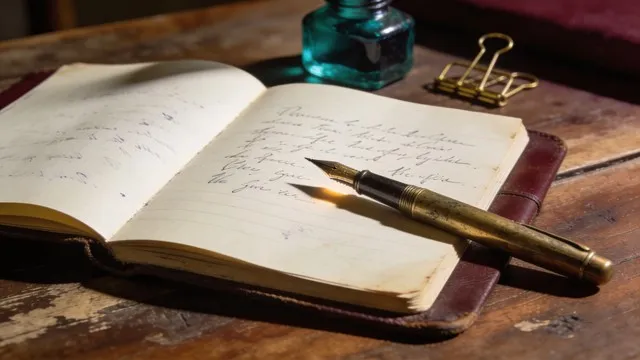
Photo: vintage handwritten journal pages cursive fountain pen on wooden desk, via images.stockcake.com
It started, like most of my worst and best ideas, at my mother's kitchen table in Ohio. She was writing a grocery list, and I caught myself staring at her hand moving across the pad — that loose, tilted cursive she's had since the Nixon administration. I realized I couldn't write that way if my life depended on it. My own handwriting is a cramped, forward-leaning slant that looks like it's trying to escape the page.
And that got me wondering: if my handwriting is always leaning forward, always in a hurry, what has it been doing to my journal entries for the last twenty years?
So I ran an experiment. For one month, I wrote my daily journal pages in someone else's handwriting — a different person each day. Not tracing, not forging signatures. I'd study a sample of their writing for ten minutes, then fill a page or two in my own words, wearing their hand like a borrowed coat.
Week One: Writing Like My Mother
The first day, I copied my mom. Her cursive is round and unhurried, letters that lean back slightly, like they're considering sitting down.
Something strange happened almost immediately. I couldn't rush. My hand physically refused to move at my usual clip, and without speed, my usual journal habits fell apart. I'm a list-maker, a bullet-point guy, a writer who treats his journal like a task manager with feelings. In her loops, none of that worked. Instead I wrote two full paragraphs about the light in my backyard and how it reminded me of a house we rented in 1998 that I hadn't thought about in decades.
I don't think that's a coincidence. I think the writing was following the hand.
The Hard Part Wasn't the Copying
People assume the challenge is mimicry. It isn't — after a few days of studying samples, you can approximate almost anyone. My brother Dave writes in tight, angular print with no spaces between words, and by day nine I could fake it well enough to fool him.
The hard part was what the handwriting did to my content.
Dave's cramped print made me write short, clipped entries — all observation, no reflection. My friend Priya, whose handwriting is immaculate architect-grade print, made me weirdly self-conscious, like the page was being graded. I wrote careful, tidy things in her hand. Polite things. Nothing I'd ever want to read back.
My college roommate Marcus, meanwhile, writes in a chaotic leftward scrawl that looks like a seismograph reading. In his hand, I wrote the rawest entries of the whole month. I'm not saying chaotic handwriting unlocks chaos on the page, but I'm not not saying that either.
What I Think Was Actually Happening
Here's my working theory: my own handwriting has become invisible to me. It's so automatic that it functions like a highway — I can get where I'm going without noticing the scenery. That's efficient, but efficiency is the enemy of a journal. A journal should be a gravel road.
Writing in someone else's hand forced my brain back into first gear. Every letter required a micro-decision. And all those small decisions kept bumping me out of autopilot, which is exactly where the interesting material lives.
There's also something about the borrowed identity. When I wrote in my grandmother's handwriting — she's been gone eleven years, but I still have a recipe card in her script — I found myself writing about her. Not because I planned to. The hand seemed to remember her before I did.
What Survived the Month
I didn't keep up the experiment. Around day 31, I went back to my own slanted sprint of a script, and honestly, it felt like putting on old shoes.
But three things stuck:
First, I slowed down on purpose now. A couple of mornings a week, I write a page as slowly as I can physically manage. Different material comes out. Slower, stranger, more honest.
Second, I stopped believing my handwriting is neutral. It's a habit, and habits have opinions. If your journal feels stale, the problem might not be your thoughts. It might be your penmanship.
Third, and this is the practical one: if you're stuck on a creative project, change the physical act, not the thinking. Write the next scene in block letters. Write it in cursive if you never do. Write with your non-dominant hand for one ugly paragraph. You're not looking for good output — you're looking to knock the autopilot loose. The constraint does the work your willpower can't.
Try It Before You Laugh
I know how this sounds. A grown man forging his friends' handwriting to journal at them. But it costs nothing, it takes ten minutes to start, and you probably have a stack of birthday cards and recipe cards and old letters in a drawer somewhere, full of hands that aren't yours.
Pick one. Study it. Fill a page.
Then pay attention to what you write, because I promise the handwriting is in the room, and it has things to say.